
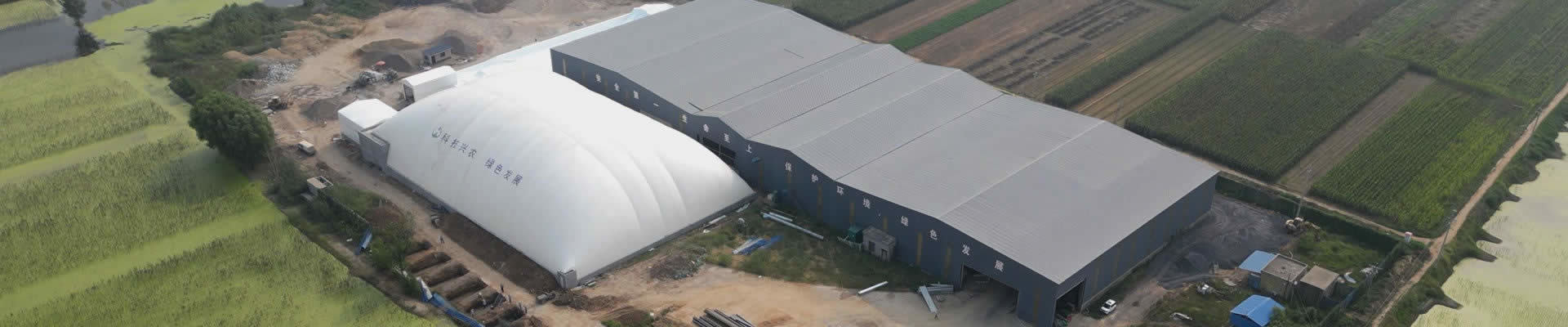
From One Month to Three By building the dome twice as tall as convention allows, XY Air Dome kept Harbin Institute of Technology's excavation covered through piling as well as digging.
Release time:
2026-08-12
Beijing Xinyuan Yijia Membrane Structure Technology Co., Ltd. has completed and commissioned the foundation pit air dome at Harbin Institute of Technology's student dormitory project. The dome stands 42 metres tall, measures 53.9 metres at its widest and covers roughly 6,475 square metres. It sits in the heart of the HIT Science Park, 13 metres from student accommodation to the south, with a canteen and teaching buildings immediately across the road to the east — an unusually demanding setting for dust and noise control. By taking the dome far higher than convention allows, XY Air Dome extended the enclosure's useful life on site from under a month to three, giving deep excavation work in sensitive campus locations a new green option.
The excavation runs 7.8 metres deep at the centre of the campus, and piling noise was the acute problem: open-air work would have cut straight across student routines and the teaching timetable. Foundation pit air domes have become a common answer to dust and noise, but on most projects they can only be used during excavation and spoil removal. A conventional dome rises to about half its span, which leaves too little usable height near the perimeter for piling rigs to work against the membrane edge — and that is what limits the enclosure's service life. Designed conventionally, this dome would have topped out at 22 metres, covering spoil removal alone, a working window of less than a month.
To resolve that — the mismatch between what a standard dome offers and the clear height piling actually needs — the XY Air Dome team took the height to nearly twice the norm, lifting the rise-to-span ratio from around 1:2 to close to 1:1 and turning a half-circle profile into something much closer to a full one. At that ratio the structure sits outside the scope of both Chinese and international membrane structure codes, which brought heavy wind loading, an awkward boundary to follow and no established design parameters to work from.

The team addressed this on three fronts.
1. A very high rise-to-span geometry. The dome provides more than 28 metres of clear internal height, enough for 86.3% of the piling work on site. That stretched the working window from under a month to three, covering both spoil removal and piling. The membrane is a high-strength grade with a tensile strength of 10,000 N/5 cm, selected to tolerate large deflections and the higher internal pressure the geometry demands.
2. Layered wind resistance. Harbin sees strong winds through spring and summer, so the team ran three-dimensional simulations across a range of wind directions and load combinations. Fan capacity went from the usual four units to six, cable net spacing was tightened from the standard 3.5–4 metres to 3 metres, and 20 mm cables were specified. High-strength membrane, a dense cable net and fan redundancy give three overlapping layers of protection for a dome this tall in high wind.
3. A cable net tailored to an irregular plan. The excavation is broadly rectangular, but the south-west corner throws out several projections, producing re-entrant and acute-angled zones. A conventional orthogonal cable net cannot follow a boundary like that, so the team laid out a diagonal orthogonal net that spreads membrane stress evenly and avoids local concentrations.
The sealed structure cuts dust and noise off at source, sparing the dormitory 13 metres away, and triples the period over which the enclosure earns its place on site.
As a significant test of very tall air dome design, the project shows that a 42-metre enclosure at close to a 1:1 rise-to-span ratio is viable in a cold, windy region. It gives comparable deep excavations needing large clear heights a technical route to follow, and gives universities, hospitals and dense city-centre sites a green construction model.
XY Air Dome will continue to develop membrane structure technology and engineering services, building experience in fully enclosed deep excavation work, very tall and irregular dome design, and cold-region high-wind conditions, so that more complex sites can be built safely, efficiently and cleanly.
Keywords:
Latest News
PRODUCTS
CONTACT US

TEl :

WHATSAPP:
+8613717559290

E-MAIL :

ADDRESS :
No. 137, 1st Floor, Block B, No. 23 Chaoqian Road, Science and Technology Park, Changping District, Beijing


Online Message